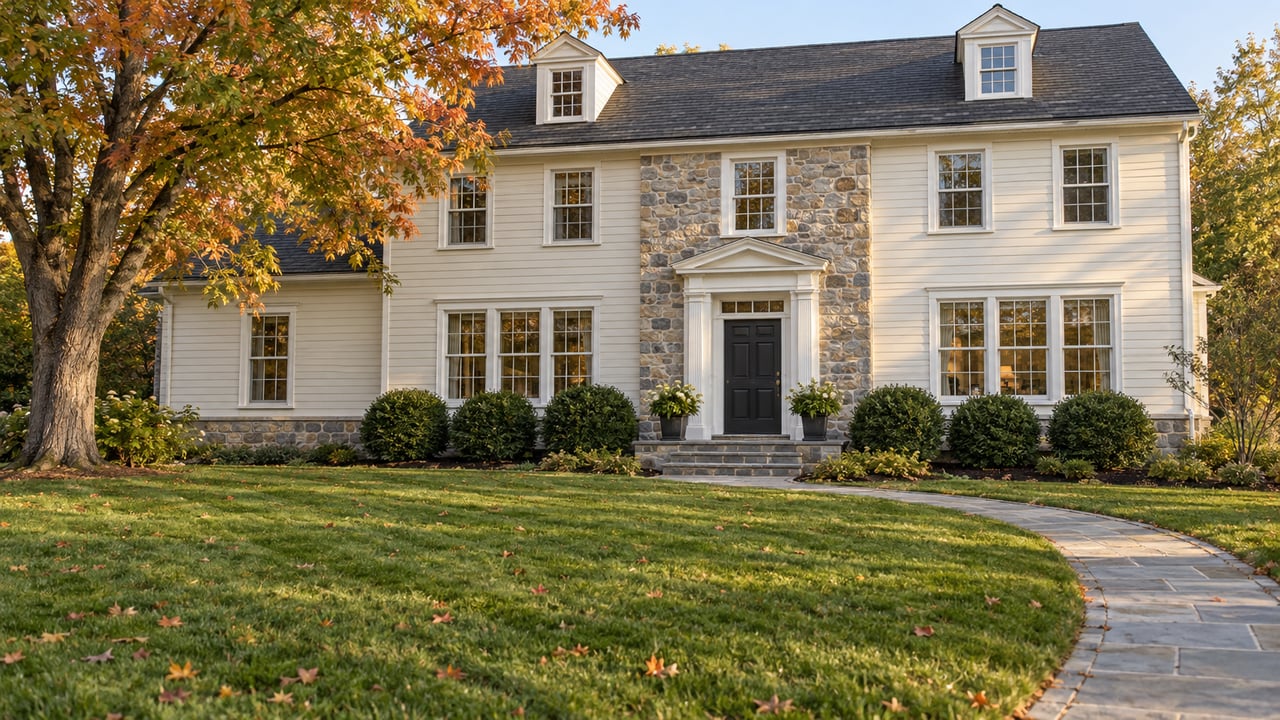
At the corner of South Finley Avenue and Colonial Drive there is a house, a yard and a historical sign. That is all that marks the place where British dragoons surrounded Widow White's Tavern on the morning of December 13, 1776, and took Continental Major General Charles Lee prisoner. The Historical Society of the Somerset Hills says the tavern itself is long gone and the site is now a private residential lot.
That one fact shapes how Bernards Township is marking the 250th anniversary this December. Nobody can gather a crowd on someone's front lawn. So the anniversary runs over three days at three public buildings, and each one covers a different part of the story.
What Happened at the Corner of Finley and Colonial
By mid-December 1776, Lee had spent weeks ignoring George Washington's repeated requests to bring his troops and join the main army. On December 12 he went ahead with a small escort and took lodging at Widow White's, away from his own men.
James Wilkinson, an officer who was there, wrote a memoir account that the local research project Mr. Local History has transcribed. He says he reached Lee's quarters around 4 a.m. and that the British showed up later that morning. The riders were Lt. Col. William Harcourt's dragoons. They surrounded the building, and Lee gave himself up after they threatened to burn the house. According to the Journal of the American Revolution, the raiding party was 28 dragoons and five officers, and Banastre Tarleton was one of them.
The capture mattered for what happened next. John Sullivan took over Lee's division and changed its route to join Washington. The Journal of the American Revolution says those troops arrived in time to help at Trenton on December 26. The general who had kept his distance was gone, and his soldiers joined the main army 13 days before the battle.
Ten O'Clock, for Reasons Still Debated
The time is about the one thing the accounts agree on. The Journal of the American Revolution puts the British approach at about 10 a.m., and Mr. Local History's summary of Wilkinson says it was around ten, as Lee and his officers were finishing breakfast and Lee was writing a reply to a letter from General Horatio Gates.
The reason Lee was there is still open, 250 years later. Mr. Local History's research on the tavern keeper lists several local versions. He was visiting Mary White. He had been invited. He was having breakfast with John Morton. He was there to meet Lord Stirling. The Journal of the American Revolution doesn't pick one. It just says he stopped there overnight.
That open question helps explain the shape of this year's program. The reenactment shows what happened, the book talk explains it, and the library talk asks what might have happened instead.
Three Days, Three Buildings
The township's America 250 page lists the series under the title "The Capture of General Charles Lee at Widow White's Tavern and Its Local Impact."
| Date | Where | What | Confirmed details |
|---|---|---|---|
| Saturday, Dec. 12 | The Stables at Lord Stirling Park | Reenactment of Lee's capture | Township calendar still reads "Details Coming Soon" |
| Sunday, Dec. 13 | The Brick Academy, 15 West Oak Street | Book talk by Christian McBurney, author of George Washington's Nemesis | 2 to 4 p.m. |
| Monday, Dec. 14 | Bernards Township Library, 32 S. Maple Ave. | Encore of Brooks Betz's "Sacking General Lee" what-if talk | 7 p.m. |
The Sunday event is the one on the actual anniversary. December 13 falls on a Sunday this year, and the township's calendar lists McBurney's talk at the Brick Academy from 2 to 4 p.m. that afternoon. The listing links to the Historical Society of the Somerset Hills. The building was put up in 1809 as a schoolhouse, decades after the war, and now holds the Historical Society's museum. It's a natural place to discuss the capture without being the spot where it happened. In March the Society also opened a new exhibit there on its recently restored 38-star American flag.
Monday's talk is a repeat. Brooks Betz first gave "Sacking General Lee at Widow White's in Basking Ridge... But What If" at the library this summer. Patch's July 13 event listing said registration was requested and that Friends of BTL sponsored the program. The December encore is scheduled for 7 p.m. Registration details for the December date weren't posted as of early October.
Saturday's reenactment has the least information so far. The township calendar names the Stables at Lord Stirling Park as the location and still says "Details Coming Soon," with no start time. Lord Stirling Park fits for a reason beyond the room it offers. Lord Stirling's 1762 manor site is part of the park today. One of the local explanations for Lee's stop is that he planned to meet Lord Stirling. The manor grounds themselves are generally closed to the public.
Somerset County is helping pay for the weekend. In May, Patch reported that Bernards Township received $17,500 through the county's 2026 grant awards "to support a series of local history events focused on General Lee's capture in 1776." The money came through the County History Partnership Program, which the Somerset County Cultural & Heritage Commission runs with the New Jersey Historical Commission.
Where the Physical Traces Ended Up
With no building left, the reminders of the tavern are spread around town, and some of them disagree with each other.
- The site sign. The Historical Society and the township both put the tavern at South Finley Avenue and Colonial Drive. Mr. Local History describes a small sign at Cedar Street and South Finley instead. Either way, it stands on or next to a private home.
- The state marker. The New Jersey Historical Commission's marker inventory lists a "Basking Ridge" marker in front of the Methodist Church on Finley Avenue. It was first put up in 1933 and replaced in 1963. The earlier text said Lee was captured at Widow White's Tavern and that Lord Stirling's estate was about two miles east.
- The brick. The Historical Society's collection includes a brick said to come from the tavern, with an old tag pasted on top.
Brick from Widow White's Tavern Where Gen. Chas. Lee was captured Donat [sic] by the Whitnall Family
Someone also painted a picture of the tavern on the brick. It shows a plain white building with no front door, a chimney, several outbuildings and fencing, all surrounded by trees that may be cedars. The Society's June write-up points out that the chimney could be where the brick came from. That painting is about as close as anyone in town can get to seeing the building.
A Short Walk That Connects the Pieces
The Brick Academy, the Presbyterian church and the Finley Avenue marker are all close to each other, so a visit on December 13 can include more than the talk.
Basking Ridge Presbyterian Church, at 1 East Oak Street, was already standing during the Revolution, though the frame church from that time was replaced in 1839. A colonial company drilled on its grounds in 1775, and 35 Revolutionary War soldiers are known to be buried in its cemetery. The large white oak that stood in the churchyard for generations isn't there anymore. A local site guide says it died in 2016 and was taken down in 2017.
From West Oak Street, the Methodist Church marker on Finley Avenue and the corner of South Finley and Colonial Drive are south of the church green. The site sign can be seen from the street. The lot behind it is a private home, so there's nothing more to see past the sign.
Before Saturday's reenactment, check the township's America 250 page for the start time. It's the only event in the series that still hasn't posted one.
If you're planning to go to any of the three days in December, I'm always glad to compare notes on how Basking Ridge's history shows up along Finley Avenue and Oak Street. Karen Boose - Coldwell Banker Realty is here when you want to talk. Let's connect.